

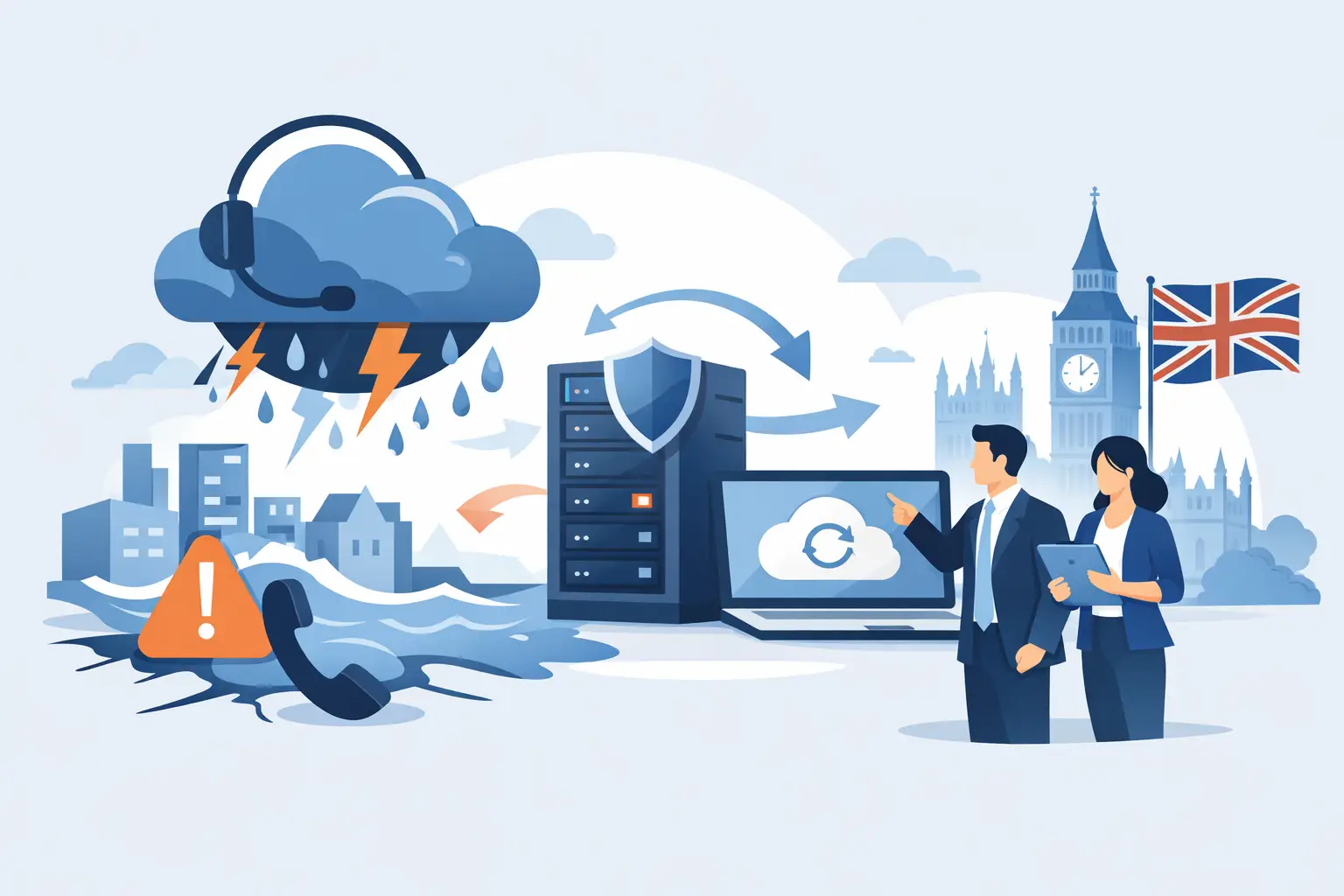
A phone system only proves its value when something goes wrong. An office loses power, a broadband circuit fails, a building is inaccessible, or a cyber incident takes systems offline. In each case, customers still expect an answer. This cloud calling disaster recovery guide sets out how UK businesses can keep people connected without turning a disruption into a prolonged customer service problem.
Cloud calling gives organisations more options than a traditional office PBX, but it is not a disaster recovery plan by itself. The platform may be available, yet your team can still be unable to take calls if they have no internet access, no working devices, unclear instructions or poorly configured call routing. Effective recovery is about people, process and technology working together.
Start with the calls your business cannot afford to miss
Not every call has the same consequence. A missed sales enquiry may mean lost revenue. An unanswered support call can affect a key customer relationship. For some organisations, calls involving safeguarding, urgent repairs, clinical services or financial activity need a different level of planning altogether.
Begin by identifying the numbers, teams and call types that are business-critical. Ask a practical question: if this phone number stopped working for four hours, what would happen? The answer will help you set a realistic recovery target rather than trying to apply the same level of protection everywhere.
For many SMEs, the priorities are the main published number, customer service queues, key departmental lines and outbound calling for staff who manage customers or suppliers. A contact centre may also need access to live queue information, call recordings, customer records and supervisor tools. Recovery planning should reflect these dependencies, not just whether a handset can make a call.
Build your cloud calling disaster recovery plan around real scenarios
A useful plan is written for events your business could genuinely face. It should be short enough that a manager can use it under pressure, with clear ownership and simple activation steps.
Consider the difference between an office-specific event and a wider connectivity issue. If one site is unavailable, cloud calling should allow users to work from home, another office or a mobile device. If the local broadband fails but the building is safe, staff may need mobile data or a secondary connection. If there is a wider provider outage, the plan may require temporary call forwarding, alternative contact channels and straightforward customer messaging.
Your plan should specify who can make changes to call routing, who tells staff what to do, and who keeps customers informed. Avoid a document that depends on one person knowing every portal password or configuration detail. A small group of authorised people should have access, with multi-factor authentication and securely managed credentials.
Agree recovery objectives before choosing the solution
Two measures bring useful discipline to the conversation. Your recovery time objective is how quickly calling needs to be restored. Your recovery point objective is how much recent data, such as call recordings, voicemail or reporting information, you can accept losing.
A reception number may need to divert within minutes. A back-office team may be able to manage with a longer interruption. There is no single correct target, because the right balance depends on customer expectations, risk and budget. The key is to make the decision deliberately, then configure and test for it.
Design for more than one route into the business
The strongest plans avoid relying on a single building, connection, device or individual. Cloud telephony makes this more achievable, but the design needs care.
Calls to your main number can be routed to hunt groups, auto attendants, remote users or mobile numbers. In an incident, an authorised person may switch a queue to an alternative group, send calls to a temporary answer service or apply a clear out-of-hours message. The right option depends on whether the business can still serve callers properly. Forwarding every call to personal mobiles may sound reassuring, but it can create privacy, cost and capacity issues if it is not planned.
For key teams, consider a mix of desk phones, softphone applications and mobile calling. If staff can use a managed app on a laptop or mobile, they are less dependent on a particular office or handset. However, this only works if users know how to sign in, use their business caller ID and handle transfers or voicemails away from their usual desk.
Connectivity matters too. A secondary broadband circuit, 4G or 5G failover, and sensible network prioritisation can reduce the impact of local internet issues. Mobile failover is valuable, but it has limits: indoor coverage, data allowances and local network congestion can all affect performance. Test it at the sites that matter, rather than assuming the signal shown on a coverage map will be enough.
Protect the people behind the call flow
Technology can redirect a call in seconds. People still need to know what to say, where to work and when to escalate an issue.
Give every affected team a simple incident playbook. It should explain how they will be contacted, which device or app to use, what happens to their usual calls, and how to report problems. Customer-facing colleagues also need agreed wording. A calm, honest message such as “we are experiencing a temporary service issue and are working to respond as quickly as possible” is far better than silence or inconsistent explanations.
This is especially relevant for hybrid teams. A recovery plan that assumes everyone has a quiet home workspace, reliable broadband and access to company equipment may fail at the first real test. Identify staff who need loan devices, headsets, mobile access or an alternative place to work. Accessibility should be part of this conversation too, including how colleagues and customers with communication needs will be supported during an outage.
Do not overlook security and compliance during an incident
Disruption creates pressure, and pressure can lead to shortcuts. Staff may use unapproved personal apps, share sensitive details by text message or forward calls to numbers that are not appropriate for customer data. A sensible disaster recovery plan gives teams safe alternatives before they need them.
Set policies for remote access, recording, call data and the use of personal devices. If calls are redirected externally, confirm how caller information is displayed and whether recordings, payment processes or identity checks continue to meet your obligations. For regulated businesses, the recovery procedure should be reviewed alongside wider business continuity and data protection requirements.
Also consider emergency calling. Remote and mobile users may not be at the registered office address when they place an emergency call. Make sure your teams understand the organisation’s process and the information they may need to provide. This is one area where a quick technical configuration check can have serious real-world value.
Test the plan when the pressure is low
A disaster recovery plan that has never been tested is a set of assumptions. Testing does not need to create disruption. Start with a tabletop exercise: present a realistic scenario and ask the responsible people to work through the first hour. You will quickly find missing contact details, unclear permissions and call flows that make sense on paper but not in practice.
Then carry out controlled technical tests. Try routing the main number to remote users, logging in through mobile data, taking calls from an alternative location and checking whether voicemail, transfers, reporting and customer records behave as expected. For contact centre teams, test queue overflow rules and supervisor visibility as well as individual agent calling.
A useful quarterly review should cover at least these four areas:
- Call routes, opening hours, overflow destinations and published numbers.
- User access, licences, devices and remote-working readiness.
- Internet resilience, mobile failover and power arrangements at key sites.
- Staff responsibilities, supplier contacts and customer communication templates.
Keep a record of what the test revealed and assign actions with dates. Recovery planning improves through small corrections, not through a policy document left untouched for a year.
Work with partners who understand the operational picture
Your communications provider should be able to explain how your platform behaves during a failure, who can alter routing, what support is available and where the boundaries of responsibility sit. This matters most when several services are involved, such as hosted telephony, Microsoft Teams voice, SIP connectivity, contact centre tools and mobile services.
At Bulb Tech, the conversation starts with how your people work and what customers need from you when normal operations are interrupted. The technical design matters, but so does making the plan understandable for the people who will use it.
The best time to make a recovery decision is before a customer is waiting on hold and your team is searching for answers. Set aside an hour, choose one likely disruption scenario and walk through what would happen next. You may find that a few well-chosen changes make a difficult day far more manageable.
