

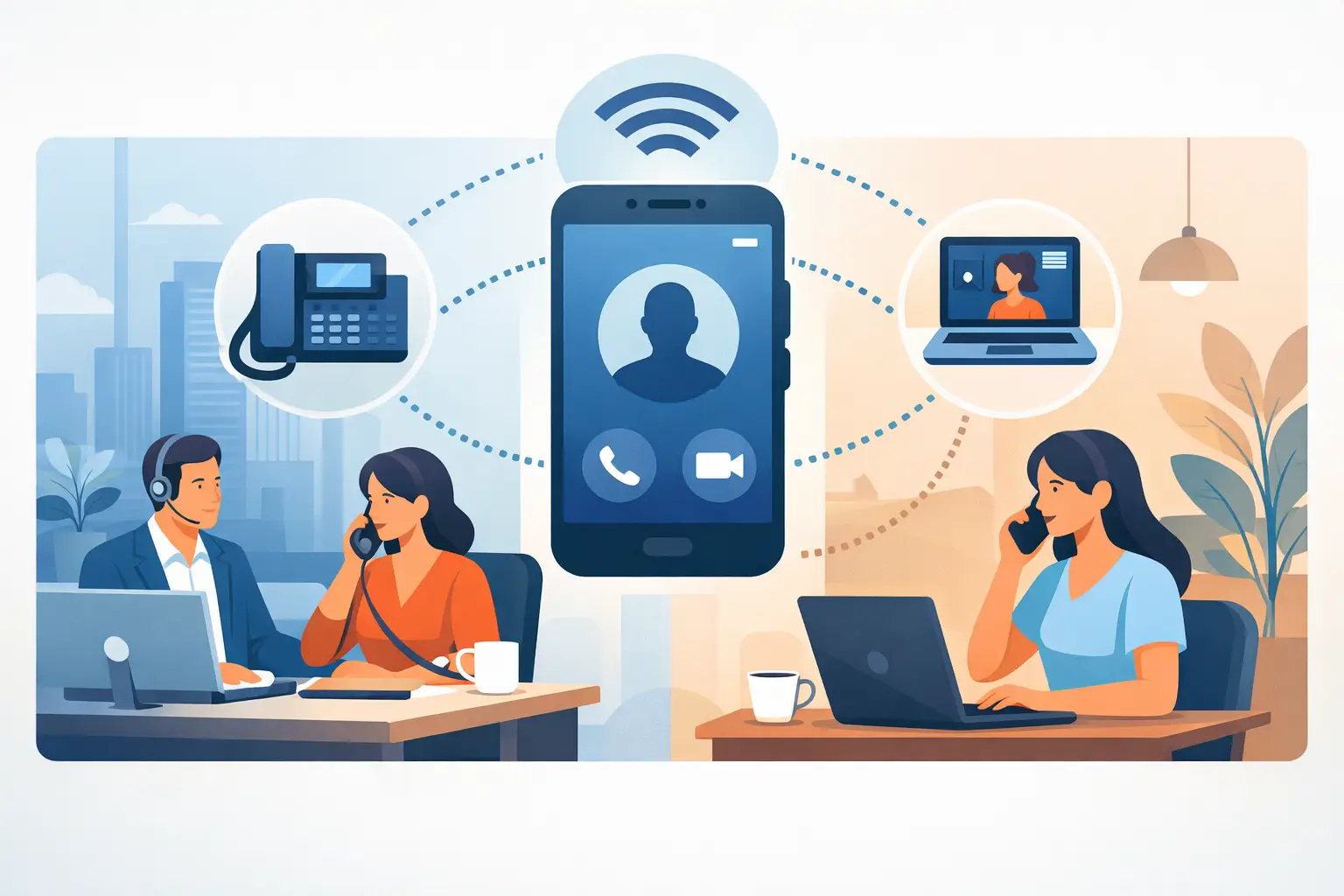
Monday starts in the office for some people, at home for others, and on the road for everyone else. That is exactly why a business phone system for hybrid working has moved from a nice-to-have to a core part of how modern companies operate. If customers cannot reach the right person quickly, or staff are juggling mobiles, desk phones and missed calls, the cracks show fast.
Hybrid working has changed more than where people sit. It has changed how calls need to flow through a business, how teams collaborate, and how leaders think about availability, service levels and cost control. The old model – a fixed office phone system built around a single location – simply does not fit many businesses anymore.
What a business phone system for hybrid working needs to do
A hybrid setup is not just remote working with a different label. Some people are in the office every day, some split their week, and some are mainly mobile. That means your phone system has to support different working patterns without creating a different experience for every caller.
At a practical level, staff should be able to take and make business calls from wherever they are, using the same number, the same core features and the same professional presence. Customers should not need to know or care whether someone is at a kitchen table, in head office or between meetings.
That sounds simple, but it depends on getting a few essentials right. Call routing needs to be flexible. Voicemail has to be easy to access. Hunt groups and call queues should work consistently across devices. Reporting matters too, especially for customer-facing teams where service standards cannot be left to guesswork.
A good setup also needs to work with the tools your team already uses. For many businesses, that means bringing calling into collaboration platforms rather than forcing people to switch between disconnected systems. The less friction there is, the more likely people are to use the system properly.
Why legacy systems struggle with hybrid working
Traditional PBX systems were built for a world where people came to one place to do their job. They can still work well in the right environment, but hybrid working exposes their limits quickly.
The first issue is flexibility. Adding users, redirecting calls or supporting home and mobile workers often becomes more awkward than it should be. In some cases, businesses end up patching the gaps with personal mobiles, manual call forwarding or separate apps. That creates inconsistency for staff and confusion for customers.
The second issue is visibility. When calls are spread across office handsets and mobiles, managers can lose sight of what is happening. Are calls being answered? Are teams overloaded at certain times? Are customers waiting too long? Without proper reporting and central control, service quality becomes harder to manage.
Then there is cost. Legacy estates often come with maintenance overheads, line rental, ageing hardware and limited room to scale. For a growing business or one adjusting to changing working patterns, that can become an expensive way to stand still.
The case for cloud-based calling
For most organisations adapting to hybrid working, cloud telephony is the more natural fit. It gives businesses the ability to move calls, users and features around without tying everything to a single office location.
That matters because hybrid working is rarely static. Team sizes change. Office footprints shift. Departments move between home and site depending on workload. A cloud-based phone system makes it easier to respond without ripping out infrastructure every time the business evolves.
It also tends to support a cleaner user experience. Employees can answer calls on a desk handset, laptop or mobile app, depending on how they work. The key point is consistency. The system should feel like one joined-up platform, not a mix of temporary fixes.
For decision-makers, there is another advantage: predictable monthly costs. Moving away from large capital spend and towards a managed service model can make budgeting easier, especially for SMEs watching spend closely.
Features that make the biggest difference
Not every feature matters equally. A lot depends on how your teams work and how your customers contact you. Still, there are some capabilities that make a real difference in a hybrid environment.
Mobile and desktop calling apps are near the top of the list because they let staff stay reachable without being tied to one device. Intelligent call routing is just as important, especially when office attendance varies by day. If a caller chooses sales, support or accounts, the system should direct them quickly to the right team, regardless of location.
Voicemail to email remains useful because it reduces the chance of missed messages sitting unheard on a physical handset. Auto attendant menus can help create a consistent front door for the business, though they need to be designed carefully. Too many options frustrate callers rather than helping them.
For service-led teams, call reporting and analytics matter more than many businesses expect. In a hybrid setting, assumptions are risky. Good reporting shows answer rates, missed calls, peak periods and team performance, helping leaders make practical staffing decisions instead of reactive ones.
If your business already relies on Microsoft Teams, voice integration can also be a sensible route. It brings telephony into a platform many employees already use throughout the day, which can reduce training time and improve adoption. That said, it is not automatically the right answer for every business. Some need more advanced call handling or contact centre functionality than a basic setup provides.
Choosing the right business phone system for hybrid working
The best choice starts with your operating model, not a feature checklist. A professional services firm with a small office and highly mobile staff needs something different from a customer service team handling large call volumes across multiple locations.
Begin with call flow. Think about how customers currently reach you, where delays happen and what would improve the experience. Then look at internal needs. Do staff need softphone access? Call recording? Queue management? Direct dial numbers? Compliance support? The right system should solve actual business problems rather than adding technology for the sake of it.
It is also worth being honest about internal capacity. Some businesses want a self-serve platform and are happy managing changes in-house. Others want a partner who can guide design, deployment and ongoing optimisation. Neither approach is wrong, but choosing the wrong support model can create frustration later.
Security and resilience should be part of the conversation from the start. Hybrid working increases the number of endpoints and networks involved in daily communications. That does not mean the model is risky by default, but it does mean businesses need clear oversight, sensible policies and the right provider support.
Common mistakes to avoid
One common mistake is treating hybrid telephony as a short-term workaround. Businesses that stitched together call forwarding and mobile usage a few years ago often find those arrangements are now embedded in day-to-day operations. What worked as a stopgap can become a drag on service quality and accountability.
Another is focusing only on headline price. Cost matters, of course, but the cheapest option is not always the most economical if it creates missed calls, poor customer experiences or extra admin for internal teams. Value comes from fit, reliability and support, not just a lower monthly figure.
There is also a tendency to overcomplicate. A business does not need every available feature to support hybrid working well. In fact, too much complexity can reduce adoption. The better approach is usually to get the core journey right first, then build on it as needs change.
Why partnership matters as much as the platform
A phone system is not just a technical purchase. It affects sales responsiveness, customer service, employee experience and the day-to-day rhythm of the business. That is why relationship-led support matters.
The right provider should help you think through how calls should work in the real world, not just sell licences and move on. That includes planning the rollout, supporting number porting, helping users adapt and making sure the system continues to match the way your teams work over time.
For many UK businesses, that practical guidance is where the real value sits. Technology should make communication simpler, not leave your team trying to translate telecoms jargon into something workable. At Bulb Tech Group, that means focusing on people dealing with people and building systems around the way businesses actually operate.
Hybrid working is here to stay, but the shape of it will keep changing. A well-chosen phone system gives you room to adapt without losing control of customer experience, internal collaboration or monthly costs. If your current setup feels like a patchwork of workarounds, that is usually the signal to rethink it – and have a proper conversation about what your business needs next.
