

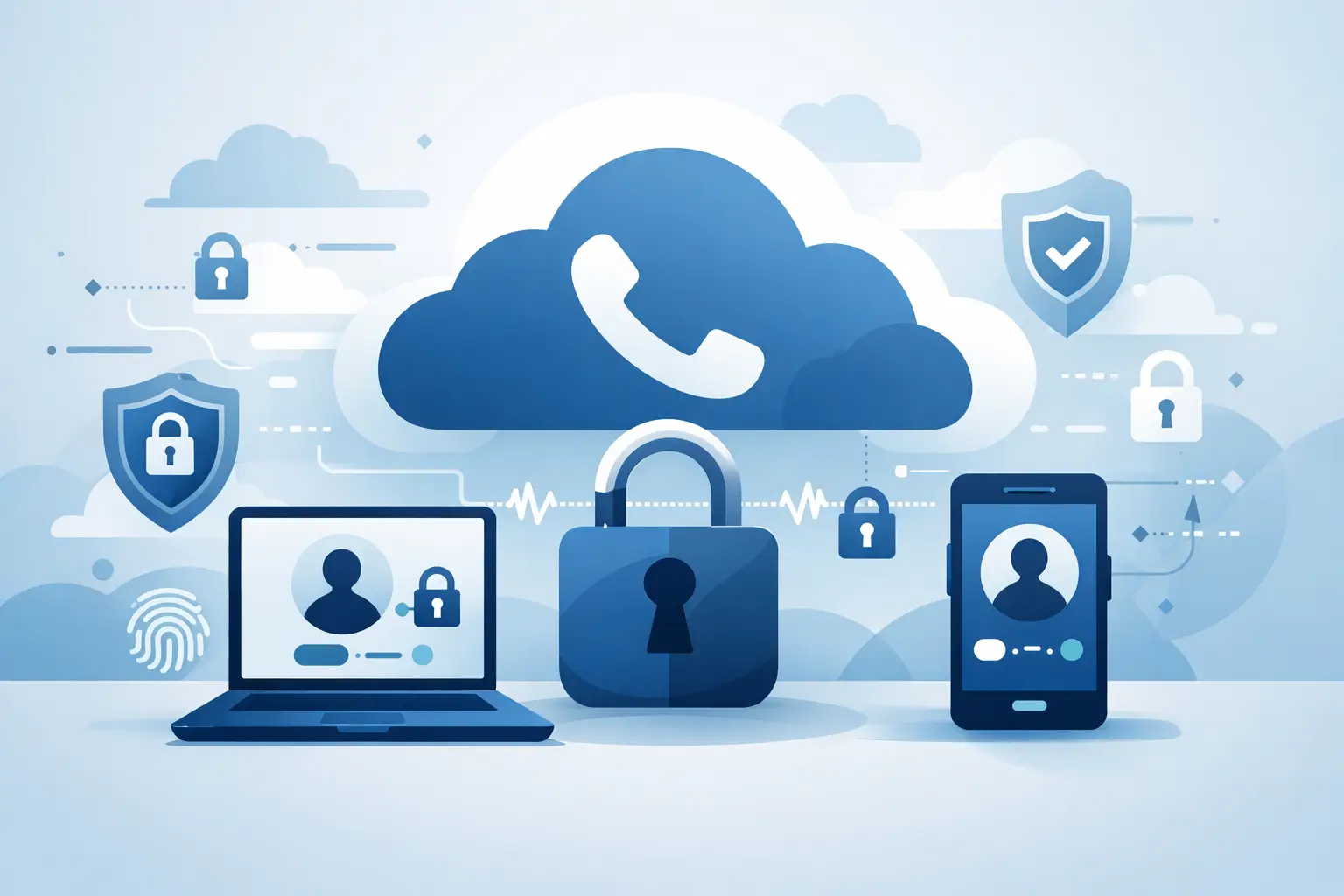
A finance director joins a call about a sensitive supplier dispute from home. A customer rings your service team to discuss account details. Your sales team uses mobile apps between meetings. In each case, the same question matters: are cloud calls encrypted?
Usually, yes – but that answer needs context. Encryption can protect a call while it travels between your device and the communications platform, yet the level of protection depends on the provider, the configuration, the devices involved and what happens to the call after it ends. For UK businesses, the aim is not simply to tick an encryption box. It is to understand where confidential conversations are protected and where sensible controls still need to sit around them.
Are cloud calls encrypted from end to end?
Most reputable cloud telephony and unified communications services encrypt voice traffic in transit. Two technologies commonly sit behind this protection: Transport Layer Security (TLS), which protects signalling information such as call setup and user registration, and Secure Real-time Transport Protocol (SRTP), which encrypts the audio itself.
Put simply, TLS helps stop someone intercepting the instructions that establish a call, while SRTP helps stop them listening to the conversation as the audio travels across a network. This is a significant improvement on older setups where voice traffic could be easier to intercept or where security relied heavily on a private office network.
However, encrypted in transit is not always the same as end-to-end encrypted. End-to-end encryption generally means only the people participating in the call can decrypt its content. Many business calling services encrypt traffic between your handset or app and the provider’s platform, then again between platform components. That is still strong, sensible protection for business telephony, but the service provider may process the media in the middle to deliver features such as call recording, voicemail, transcription, analytics, contact centre routing or connections to the public telephone network.
That distinction is worth making when a supplier says calls are “encrypted”. Ask where encryption starts and ends, whether audio is decrypted within the service to provide features, and how recorded calls are protected. Clear answers are a good sign that security is being treated as an operational responsibility, not a marketing line.
What encryption protects – and what it does not
Encryption makes intercepted voice data far less useful to an attacker. If someone captures properly encrypted traffic, they should not be able to turn it into a readable conversation without the relevant keys. It also helps protect calls made over internet connections outside the office, which is particularly valuable for hybrid teams using softphones and mobile applications.
But encryption does not make every part of a communications environment automatically safe. A call can still be exposed at either end if a laptop is compromised, a user has a weak password or a handset is left unlocked. A colleague may hear a confidential call in a shared workspace. A customer may be calling from an unsecure environment. None of these risks are solved by encrypting the journey between devices.
There are also practical boundaries. A call that leaves a cloud platform and passes into the traditional telephone network may not retain the same protection throughout every part of its route. The exact path depends on the provider, the carrier and the number being called. This does not mean cloud calling is unsafe. It means businesses should avoid assuming that one word, “encrypted”, describes every hop of every call.
Call recordings need their own security conversation
For many organisations, the biggest security question is not the live call. It is the recording that remains afterwards.
Recordings can support training, quality assurance, dispute handling and regulatory obligations. They can also contain personal data, payment-related information, health details or commercially sensitive discussions. A secure cloud calling solution should protect recordings at rest as well as when they are accessed, with controls over who can listen, download, delete or share them.
Retention matters too. Keeping every recording indefinitely is rarely a sensible default. Your business should have a clear reason for recording calls, a defined retention period and a process for disposing of recordings when they are no longer needed. If you use transcription, AI summaries or sentiment analysis, establish where that data is processed and stored, who can access it and whether it is included in your wider data protection approach.
For UK organisations, this sits alongside UK GDPR responsibilities. Encryption is an appropriate technical control, but it does not remove the need for lawful processing, access management, staff training and transparent customer communications. If calls are recorded, people should be told clearly and at the right time.
The provider matters, but your setup matters too
A well-designed hosted telephony service gives you a stronger starting point than an ageing system managed in isolation. It can centralise administration, apply updates more consistently and make it easier to support people working across offices, homes and mobile devices. Yet the configuration choices made by your business still influence the outcome.
The most useful approach is to treat call security as a shared responsibility. Your provider should explain its encryption standards, platform security, resilience arrangements and support process. Your team should control access carefully and make sure users understand the basics.
Focus on these five areas:
- Identity and access: Use strong, unique passwords and multi-factor authentication where available. Remove former employees promptly and give people only the access they need.
- Devices and apps: Keep desktops, mobiles, operating systems and calling applications up to date. Device management is particularly valuable where staff use company mobiles or work remotely.
- Network use: Encourage staff to avoid unknown public Wi-Fi for sensitive work where possible. A secure business connection or approved VPN can reduce avoidable exposure.
- Administration: Restrict who can alter call routing, download recordings, add users or make changes to permissions. These settings can have a direct impact on both security and cost control.
- People and process: Train teams to recognise suspicious login prompts, unexpected password reset requests and social engineering attempts. Attackers often target the person, not the encryption.
Questions to ask before choosing a cloud calling service
Security documentation can become technical quickly, so it helps to keep the conversation commercially focused. You need to know whether the service suits the way your business works, not just whether it contains familiar acronyms.
Ask a prospective provider whether signalling and voice media are encrypted, and which protocols are used. Ask whether calls are encrypted when users connect through desktop and mobile apps, desk phones and Microsoft Teams integrations. Ask how call recordings, voicemails and transcripts are encrypted and whether access can be controlled by role.
It is also reasonable to ask where data is hosted, what support is available if a security concern arises, and how quickly security updates are managed. If you have sector-specific obligations or handle high volumes of personal information, ask how the provider can support your compliance process without presenting encryption as a substitute for it.
Finally, test the human side. Will you be able to reach someone who understands your configuration, users and priorities when you need advice? Security is easier to maintain when the technology is matched by accountable, approachable support.
A practical balance between security and usability
The best communications security is the kind your teams can use properly. If a system is cumbersome, people find workarounds: personal mobiles, unapproved messaging apps or recordings stored in the wrong place. That can create more risk than the control was meant to prevent.
A good cloud communications design balances protection with straightforward day-to-day use. Staff should be able to take calls securely wherever they are working, supervisors should have appropriate visibility without unrestricted access, and IT teams should be able to manage permissions without a long administrative burden. Features such as secure single sign-on, role-based access and managed devices can help make that balance realistic.
At Bulb Tech Group, we see the strongest results when communications security is planned alongside call flows, hybrid working needs, customer experience and budgets. It is not a separate technical project that gets revisited only after an incident.
Cloud calls can be encrypted and highly secure, provided you understand the service boundary and put the right controls around the people, devices and data involved. Start with the questions your business genuinely needs answered, then choose a communications partner prepared to answer them plainly. Let’s talk about building a calling setup your people can trust.
