

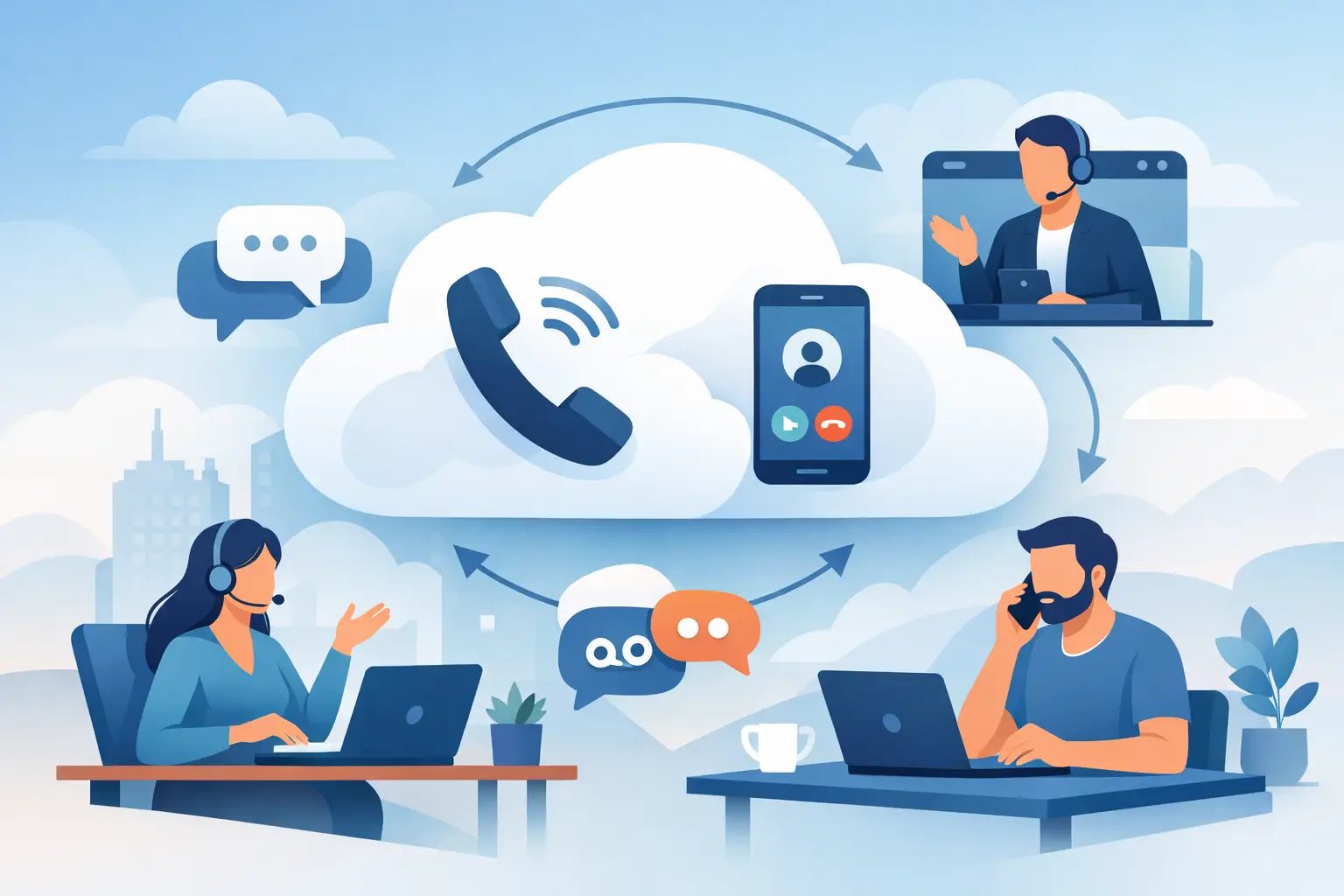
One missed customer call can tell you a lot about a business. If calls are bouncing between mobiles, office numbers and voicemail boxes that nobody checks, remote working is not the problem – the phone setup is. A cloud phone system for remote teams fixes that by giving people one business calling environment wherever they are working.
For many UK businesses, that matters more than ever. Teams are split across homes, offices, client sites and the road. Customers still expect quick answers, clear handovers and a professional experience every time they call. The challenge is not simply making calls over the internet. It is making remote and hybrid working feel joined up, manageable and reliable.
What a cloud phone system for remote teams actually changes
A cloud phone system moves business telephony away from a fixed on-site PBX and into a hosted platform. Your team can make and receive business calls through desk phones, laptops, mobiles or softphone apps, using the same business number, call routing rules and features wherever they happen to be.
That sounds straightforward, but the real value is operational. Instead of building communications around one office location, you build them around your people and your customers. Calls can reach the right department without relying on someone being sat at a particular desk. Managers can see call activity across distributed teams. New users can be added quickly without engineering work on-site.
For a growing business, that flexibility is often the difference between coping with change and constantly patching around it.
Why remote teams struggle with traditional phone systems
Legacy telephony was designed for a more fixed working model. It worked well when most people were in one building and calls followed predictable routes. Once teams spread out, those systems started showing their limits.
The first issue is consistency. Staff may give out personal mobiles, forward desk phones manually, or switch between multiple numbers depending on where they are. That creates confusion internally and externally. Customers are never quite sure which number to use, and colleagues waste time trying to work out who picked up what.
The second issue is visibility. If managers cannot see missed calls, response times or availability across a remote team, service levels become hard to manage. Problems surface late, usually when customers complain.
Then there is resilience. If your business telephony depends too heavily on one site, one line or one bit of ageing hardware, disruption at the office can quickly become disruption for the whole business. That is not ideal for customer-facing teams, and it is even less appealing for organisations trying to keep monthly costs predictable.
The business benefits go beyond flexibility
A good cloud setup does let people work from anywhere, but that is only part of the story. The bigger gains are usually around control, experience and simplicity.
Customers get a more consistent journey because calls are routed properly, voicemails are centralised, and teams can transfer calls without the awkwardness of separate systems. Sales and service staff can stay reachable on their business identity without exposing personal numbers. Leaders get clearer reporting, which helps them spot pressure points before they become service issues.
There is also a financial angle. Cloud telephony often replaces the capital cost and maintenance burden of on-site systems with a more predictable monthly model. That does not mean every business automatically pays less. It depends on user numbers, call volumes, integrations and support needs. But for many SMEs and mid-sized organisations, the move creates far better cost visibility.
How to choose the right cloud phone system for remote teams
This is where a lot of buying decisions go wrong. Businesses compare feature lists, but the better question is how the system needs to support the way your people actually work.
Start with user behaviour. Do most of your team work fully remote, or move between home and office? Are they desk-based, mobile, customer-facing, or all three? A finance team may need reliability and straightforward call handling. A sales team may care more about mobile apps, presence and CRM integration. A customer service team may need queueing, reporting and call recording.
Next, think about customer expectations. If customers contact you mainly by phone, then call flow design matters just as much as the platform itself. Auto attendants, hunt groups, overflow routing and voicemail handling need to reflect real business hours and real resource levels. There is no value in a polished menu if calls still end up with the wrong person.
Then consider management and support. A cloud phone system is easier to administer than a traditional PBX, but it still needs attention. Moves, changes, user setup, number porting, policy controls and training all matter. Many businesses want the flexibility of cloud technology without taking on another system to wrestle with. That is where a managed, relationship-led approach usually makes the difference.
Features worth caring about, and features you may not need
It is easy to get distracted by long product sheets. In practice, most remote teams need a dependable core set of capabilities: business calling on any device, intelligent call routing, voicemail to email, call transfer, reporting, and straightforward admin controls.
Some businesses will also benefit from Microsoft Teams voice integration, especially if Teams is already central to internal collaboration. Others may need contact centre functionality, compliance features, call recording or AI support tools. These can be valuable additions, but only when they solve a real operational problem.
The trade-off is complexity. More features can improve service, but they can also make systems harder to adopt if users are not trained properly or if workflows are over-engineered. The right answer is rarely the platform with the longest feature list. It is the one people actually use with confidence.
Security, compliance and reliability still matter
Remote working has made some businesses more aware of communications risk, and rightly so. When teams are spread out, you need confidence that business calls remain secure, accessible and properly managed.
That means asking practical questions. How is call data handled? What recording and retention options are available if you work in a regulated sector? What happens if an internet connection fails for one user or one site? Can calls be redirected quickly if there is an outage?
A cloud model can improve resilience, but only if the wider setup is planned properly. Connectivity, mobile backup options, user permissions and support arrangements all play a part. A system is only as reliable as the thinking behind it.
Migration is easier than many businesses expect
One reason companies delay change is the assumption that replacing telephony will be disruptive. Sometimes that concern is fair, particularly if you have multiple sites, legacy numbers, old contracts or complex call flows. But with proper planning, migration is usually more manageable than expected.
The key is to treat it as an operational change, not just a technical one. Number porting, device setup, user training and customer-facing continuity all need to be mapped out. The smoother projects tend to involve a clear rollout plan, realistic timelines and support that does not disappear after go-live.
This is where people dealing with people really matters. Technology should simplify communications, not make your team feel abandoned in the middle of a change project. Businesses often need a partner who can explain what is happening, adapt to real-world issues and keep the process clear.
When a cloud phone system is not the perfect fit
Most modern businesses with remote or hybrid staff will gain from hosted telephony, but there are still some it depends scenarios.
If your internet connectivity is poor across key locations, that needs addressing first or at least factoring into the design. If your call handling is extremely basic and unlikely to change, a full feature-rich deployment may be more than you need. If your organisation has unusual compliance requirements, sector-specific workflows or legacy systems tied into telephony, the solution may need more careful shaping.
That is not a reason to avoid cloud. It is a reason to avoid one-size-fits-all thinking.
A better question than “should we move?”
For many organisations, the real question is no longer whether cloud telephony is the future. It is whether your current phone setup is helping your remote team do their best work, or quietly getting in the way.
The right cloud phone system for remote teams gives your business room to grow, keeps customers connected to the right people, and makes day-to-day communications easier to manage. It should feel straightforward for users, useful for managers and commercially sensible for the business. If that is not what your current setup delivers, it may be time to have a more practical conversation about what better looks like. Let’s talk about building a phone system around your people, not around old limitations.
